What IQ score makes someone a genius?
Is an IQ of 130 enough? What about 140, 145, or even 160?
If you’ve ever looked up a genius IQ rating, you’ve probably noticed that different websites give different answers. Some call an IQ of 130 genius-level, while others suggest 140 or 145 as the threshold.
The reason for this disagreement is simple: there is no single, universally accepted IQ score that officially defines a genius.
IQ tests measure performance on particular cognitive tasks. The word genius, however, is a broader description that people use for exceptional intellectual ability, creativity, or achievement.
Still, IQ scores can tell us something useful about how unusual a particular test result is.
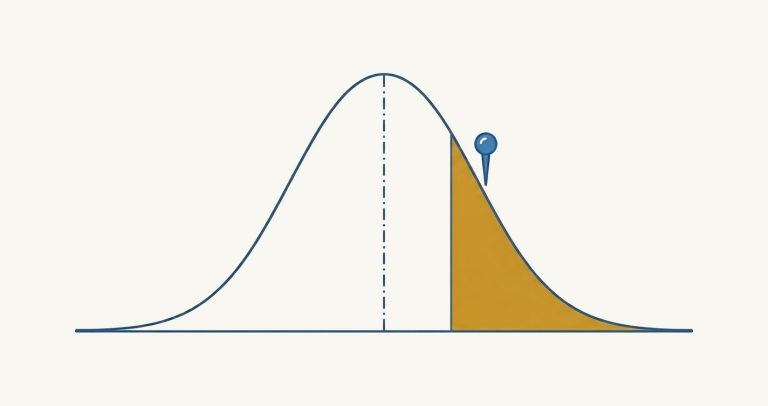
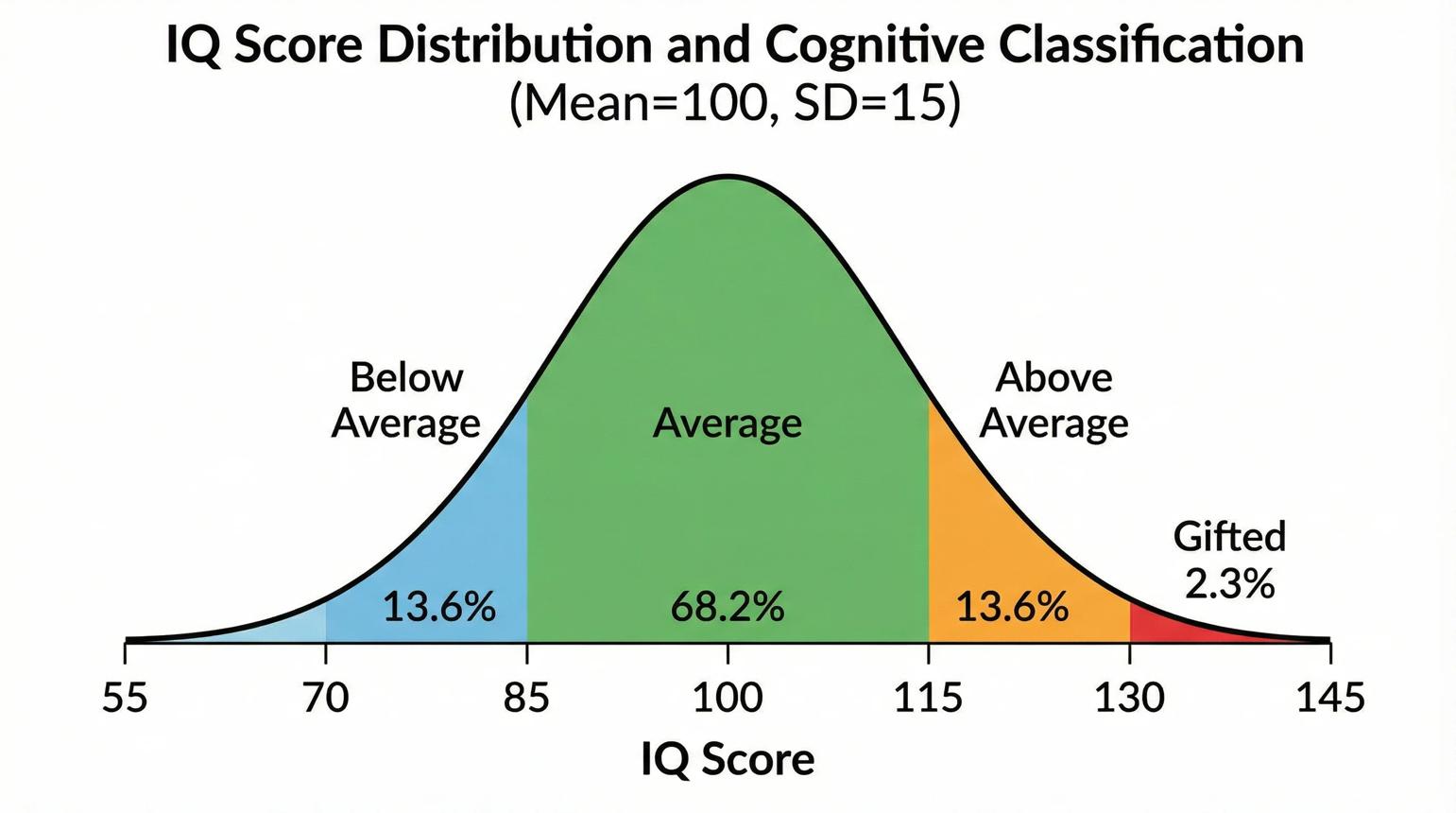
On many modern IQ scales, the average score is 100, with a standard deviation of 15. Under a normal-distribution model, an IQ of 130 is approximately at the 98th percentile, while an IQ of 145 is around the 99.87th percentile.
In this guide, we’ll explain what different high IQ scores mean, how rare they are, and why intelligence is more complicated than a single number.
What Is a Genius IQ Rating?
A genius IQ rating has no universally recognized cutoff. However, IQ scores of 130 and above are generally considered very high, while scores around 140 or 145 are sometimes informally described as genius-level.
These descriptions are not interchangeable with formal classifications used by psychologists.
Different intelligence tests may use different descriptive categories, and some don’t use the word genius at all.
Here’s a quick overview:
- IQ 100: Average on a scale standardized with a mean of 100.
- IQ 115: Approximately one standard deviation above average.
- IQ 130: Approximately two standard deviations above average, or the 98th percentile.
- IQ 140: An exceptionally high score, around the 99.62nd percentile.
- IQ 145: Approximately three standard deviations above average, or the 99.87th percentile.
- IQ 160: An extremely rare score under the theoretical distribution, although measurement limitations become especially important at this level.
These figures assume a standard deviation of 15.
An individual score should always be interpreted using the norms, measurement error, and procedures of the specific test.
Genius IQ Score Chart: IQ Levels and Percentiles
The following chart shows how different IQ scores compare with the general population under a theoretical normal distribution.
It assumes:
- A mean IQ of 100.
- A standard deviation of 15.
- An approximately normal distribution of scores.
| IQ Score | Approximate Percentile | Percentage Scoring at or Above | General Interpretation |
|---|---|---|---|
| 100 | 50th | 50% | Average |
| 110 | 75th | 25.2% | Above average |
| 115 | 84th | 15.9% | Above average |
| 120 | 91st | 9.1% | High relative to average |
| 125 | 95th | 4.8% | Well above average |
| 130 | 97.7th | 2.3% | Very high |
| 135 | 99.0th | 1.0% | Exceptionally high |
| 140 | 99.62nd | 0.38% | Exceptionally high |
| 145 | 99.87th | 0.135% | Exceptionally high |
| 150 | 99.957th | 0.043% | Extremely rare |
| 160 | 99.9968th | 0.0032% | Extremely rare |
Note: These percentiles are theoretical approximations, not official classification labels from a particular IQ test. Real-world test scores include measurement uncertainty, and extreme scores may be less precise.
How to Read the IQ Percentile Chart
An IQ percentile tells you how a score compares with scores in a reference population.
For example, an IQ of 130 corresponds to approximately the 97.7th percentile.
That means a score of 130 is higher than approximately 97.7% of scores in the modeled population.
It does not mean that someone answered 97.7% of test questions correctly.
Likewise, an IQ of 145 at approximately the 99.87th percentile does not mean someone is 99.87% intelligent.
Percentiles describe relative standing, not the total amount of intelligence a person possesses.
If you’d like a broader explanation of score ranges, see our guide to IQ test scores and what they mean.
Is an IQ of 130 Considered Genius?
An IQ of 130 is a very high score on a test with a mean of 100 and a standard deviation of 15.
It falls approximately two standard deviations above the mean.
Under the theoretical normal distribution, about 2.3% of people score at or above this level.
That makes an IQ of 130 uncommon, but it doesn’t automatically establish that someone is a genius.
What Does an IQ of 130 Mean?
A score around 130 suggests unusually strong performance relative to the test’s standardization sample.
Depending on the assessment, this may reflect strengths in areas such as:
- Verbal reasoning.
- Visual or spatial reasoning.
- Working memory.
- Abstract problem-solving.
- Processing speed.
Not every IQ test measures these abilities in the same way, and an overall score can conceal meaningful differences between individual cognitive strengths.
For example, someone may perform exceptionally well on verbal reasoning tasks but less strongly on timed processing tasks.
A comprehensive assessment considers the pattern of scores, not just the overall number.
Is 130 the Threshold for Giftedness?
An IQ around 130 is sometimes used as one criterion in gifted education or high-ability identification.
However, giftedness is not defined identically across schools, programs, or countries.
Some programs use multiple criteria, including achievement, creativity, teacher observations, or specific areas of ability.
Therefore, IQ 130 is not a universal cutoff for either giftedness or genius.
Is an IQ of 140 Considered Genius?
An IQ of 140 is exceptionally high.
On a standard deviation 15 scale, it is approximately 2.67 standard deviations above the mean.
Its theoretical percentile is about 99.62.
That means approximately 0.38% of the modeled population would score at or above 140.
In everyday discussions, a score of 140 may be described as genius-level IQ.
But this is an informal description rather than a standardized clinical designation.
How Rare Is an IQ of 140?
Under the normal-distribution model, approximately 1 in 261 people would score 140 or higher.
That is considerably less common than an IQ of 130.
However, the difference between two high scores should not be interpreted without considering measurement error.
An observed IQ score is an estimate of performance, not a perfectly precise measurement of a fixed personal trait.
Is an IQ of 145 Considered Genius?
An IQ of 145 is approximately three standard deviations above the mean on a standard deviation 15 scale.
Its theoretical percentile is around 99.87.
This places it among the highest-scoring portion of the population.
Some informal IQ classification charts label scores of 145 or above as genius-level.
However, 145 is not an internationally standardized definition of genius.
How Rare Is an IQ of 145?
Under a normal-distribution model, approximately 0.135% of people score 145 or higher.
That is roughly 1 in 741 people.
These figures describe the theoretical distribution.
They do not guarantee that every IQ test can reliably distinguish a score of 145 from nearby scores.
The actual interpretation depends on the assessment, its norms, and the confidence interval associated with the result.
What Does an IQ of 160 Mean?
An IQ of 160 is an extremely high score.
On a scale with a mean of 100 and standard deviation of 15, it is four standard deviations above average.
Under the theoretical normal distribution, only about 0.0032% of scores would reach 160 or higher.
That’s approximately 1 in 31,600.
However, extreme IQ scores require particular caution.
Why Very High IQ Scores Are Difficult to Interpret
Most standardized intelligence tests are designed to provide useful information across a broad range of abilities.
At the upper end of the scale, several challenges can arise.
1. Test ceilings
Some tests have limited ability to distinguish between people performing at exceptionally high levels.
2. Measurement error
IQ scores are estimates, and the uncertainty surrounding a result matters.
3. Normative sample limitations
Very high scores are rare, making them harder to estimate precisely from a standardization sample.
4. Differences between tests
Two assessments may measure different cognitive abilities or use different scoring methods.
For these reasons, a claimed IQ of 160 should not be treated as an exact or universally comparable measurement without information about the test.
How Rare Is a Genius-Level IQ?
The rarity of a high IQ depends on the score threshold being used.
Since genius-level has no universal definition, it’s more accurate to compare specific scores.
| IQ Threshold | Approximate Share of Population | About 1 in… |
|---|---|---|
| 130+ | 2.28% | 44 |
| 135+ | 0.98% | 102 |
| 140+ | 0.38% | 261 |
| 145+ | 0.135% | 741 |
| 150+ | 0.043% | 2,330 |
| 160+ | 0.0032% | 31,600 |
These are theoretical estimates assuming a normal distribution with mean 100 and standard deviation 15.
Why Do High IQ Scores Become So Rare?
IQ scores are commonly standardized to approximate a bell-shaped distribution.
Most people score near the average.
As scores move farther above or below the mean, fewer people fall into those ranges.
For example:
- An IQ of 115 is one standard deviation above average.
- An IQ of 130 is two standard deviations above average.
- An IQ of 145 is three standard deviations above average.
- An IQ of 160 is four standard deviations above average.
Each step represents an increasingly uncommon position in the modeled distribution.
But rarity alone does not determine whether someone is creative, successful, wise, or capable of extraordinary accomplishments.
How Are IQ Scores Measured?
IQ scores are obtained through standardized assessments designed to measure selected cognitive abilities.
Modern intelligence testing typically uses age-based norms to compare an individual’s performance with that of a reference group.
Two well-known assessment families include the Wechsler intelligence scales and Stanford–Binet intelligence scales.
What Do IQ Tests Measure?
Depending on the test, assessment tasks may examine:
Verbal comprehension
The ability to understand and reason with language.
Fluid reasoning
The ability to identify patterns and solve unfamiliar problems.
Visual-spatial ability
The ability to understand and manipulate visual information.
Working memory
The ability to temporarily hold and work with information.
Processing speed
The speed and accuracy with which someone completes certain relatively simple cognitive tasks.
These abilities can contribute to an overall IQ score, although the exact structure differs between assessments.
Why Does the Type of Test Matter?
Not all tests use identical scoring systems.
For example, some older IQ scales used a standard deviation of 16 rather than 15.
That means the same numerical score can represent a different percentile depending on the scale.
A score of 140 should therefore be interpreted in the context of the specific assessment.
The testing environment, language, accessibility accommodations, and individual circumstances can also affect performance.
What Is a Confidence Interval?
A confidence interval communicates uncertainty around an estimated score.
For example, a professionally administered assessment may report a full-scale IQ along with a range of plausible scores.
This is more informative than treating a single number as perfectly exact.
The width of the interval depends on the test and its measurement characteristics.
When interpreting high IQ results, the confidence interval can be particularly important.
Does a High IQ Mean Someone Is a Genius?
Not necessarily.
A high IQ score and the broader concept of genius are related in some everyday discussions, but they are not identical.
IQ tests provide information about performance on standardized cognitive tasks.
The term genius may refer to exceptional intellectual ability, original thinking, creativity, or accomplishments that significantly influence a field.
IQ Is Not the Same as Creativity
Someone can perform very well on standardized reasoning tasks without necessarily producing highly original artistic, scientific, or technological work.
Likewise, creativity can involve abilities and experiences not fully captured by a general IQ score.
IQ Is Not a Guarantee of Success
Achievement depends on many factors beyond cognitive test performance.
These may include:
- Education and opportunity.
- Motivation and persistence.
- Health and well-being.
- Social support.
- Access to resources.
- Skills and experience relevant to a particular field.
IQ can be associated with certain educational and occupational outcomes at the group level, but it cannot predict an individual’s entire future.
IQ Doesn’t Measure Every Human Strength
An IQ test isn’t designed to provide a complete evaluation of someone’s personality, empathy, integrity, practical judgment, or artistic ability.
A person may have important strengths that aren’t well represented by an IQ score.
That’s why it is more accurate to describe an IQ result as one source of information about cognitive performance rather than a complete measure of human potential.
What About Famous Geniuses and Their IQ Scores?
You may have seen claims that Albert Einstein had an IQ of 160 or that other historical figures had scores above 180 or 200.
Such numbers are frequently repeated online.
However, many historical IQ estimates are speculative.
For someone who never completed a documented, appropriately standardized IQ assessment, an exact score cannot be reliably established.
Exceptional scientific or creative achievements do not allow us to calculate a precise IQ retrospectively.
Even when a famous person’s test score is reported, the original test, scoring method, and supporting documentation matter.
A list of celebrity IQ scores should not be treated as scientific evidence unless the scores are well documented and comparable.
Are Online Genius IQ Tests Accurate?
Online IQ quizzes can be entertaining, but their results vary considerably in quality.
A website may display a score of 140 or 160 after a short series of puzzles.
That number does not automatically have the same meaning as a score obtained from a professionally standardized intelligence assessment.
Why Online IQ Results Can Be Misleading
Some online tests:
- Don’t use representative standardization samples.
- Provide little information about reliability or validity.
- Use scoring systems that aren’t clearly explained.
- Focus narrowly on a single type of puzzle.
- Exaggerate high scores to make results more appealing.
This doesn’t mean every online cognitive test is useless.
Some may provide interesting practice or insight into particular reasoning tasks.
But a short quiz should not be treated as a definitive measure of general intelligence.
How Can You Get a More Reliable IQ Assessment?
If you need an IQ score for educational, clinical, or other formal purposes, consider an assessment administered and interpreted by an appropriately qualified professional.
They can explain:
- Which test is suitable.
- What abilities the assessment measures.
- How the scores compare with the relevant population.
- What confidence intervals mean.
- Whether differences between subtest scores are meaningful.
Professional interpretation is especially useful when the purpose extends beyond curiosity.
Can You Improve Your IQ Score?
IQ scores are not necessarily identical throughout a person’s life.
Performance can be influenced by development, education, health, practice effects, and other circumstances.
However, improving performance on a particular task is not the same as producing a broad, lasting increase in general cognitive ability.
Does Practicing IQ Questions Help?
Practice may improve familiarity with certain question formats.
For example, someone who regularly solves matrix reasoning puzzles may become more efficient at recognizing common patterns.
But improvement on practiced tasks doesn’t automatically transfer to every aspect of intelligence.
What About Brain Training?
Claims that a particular game, app, or exercise can dramatically increase IQ should be evaluated carefully.
Some cognitive training programs improve performance on the tasks being practiced.
Evidence for broad transfer to unrelated abilities is more limited and depends on the intervention and outcome being measured.
What Supports Cognitive Function?
General habits that support learning and cognitive performance include adequate sleep, physical activity, access to education, and appropriate healthcare.
These habits are valuable for overall well-being, even when they don’t produce a specific increase in IQ points.
It’s also worth remembering that intelligence is not the only factor that matters for learning, problem-solving, or success.
Frequently Asked Questions
What IQ score is considered genius?
There is no universally accepted genius IQ cutoff. Scores of 130 and above are generally considered very high on a standard deviation 15 scale, while 140 or 145 may be informally described as genius-level. These are not standardized clinical definitions.
Is 130 IQ considered genius?
An IQ of 130 is approximately at the 97.7th percentile on a scale with a mean of 100 and standard deviation of 15. It is a very high score, but it does not automatically establish that someone is a genius.
Is 140 IQ a genius IQ?
An IQ of 140 is exceptionally high, approximately at the 99.62nd percentile. Some informal classifications describe this as genius-level, but there is no universal professional threshold defining genius.
Is an IQ of 145 considered genius?
An IQ of 145 is approximately three standard deviations above average, around the 99.87th percentile. It is sometimes informally called genius-level, although the term is not a standardized clinical classification.
How rare is an IQ of 160?
Under a theoretical normal distribution with a mean of 100 and standard deviation of 15, approximately 1 in 31,600 people would score 160 or higher. Actual interpretation depends on the test’s measurement range and precision.
What is the average IQ score?
Many modern IQ tests are standardized so that the average score is 100. A standard deviation of 15 is common, although not universal.
What percentage of people have an IQ above 130?
Under a normal-distribution model with a mean of 100 and standard deviation of 15, approximately 2.28% of people score at or above 130. The percentage strictly above 130 differs slightly depending on how scores are rounded and reported.
Can you have a high IQ without being a genius?
Yes. A high IQ reflects strong performance on particular cognitive measures, while genius is a broader, informally defined concept that may involve creativity, innovation, or exceptional achievement.
Are online IQ tests accurate?
Accuracy varies. Many casual online quizzes lack the standardization, reliability evidence, and professional interpretation associated with established intelligence assessments. Their results should not automatically be treated as formal IQ scores.
Can IQ scores change over time?
Yes. Scores can vary with development, health, testing conditions, measurement error, and other factors. However, a change in a reported score doesn’t always mean an equivalent change in underlying cognitive ability.
Final Thoughts
So, what is a genius IQ rating?
There isn’t one official number.
An IQ of 130 is already very high, while scores of 140, 145, and 160 occupy increasingly rare positions in the theoretical IQ distribution.
But calling someone a genius based on a single score oversimplifies what intelligence means.
IQ tests can provide useful information about cognitive abilities, especially when they are standardized and interpreted appropriately.
They cannot fully capture creativity, wisdom, motivation, character, or a person’s potential to contribute something meaningful to the world.
If you’re trying to understand a high IQ score, focus on the specific test, its percentile ranking, and its measurement limitations rather than a dramatic label.
A high IQ score can describe exceptional test performance. It doesn’t need the label “genius” to be meaningful.
Sources and Further Reading
- Mensa International — Information about qualifying intelligence tests and high-IQ society admission criteria.
- Pearson Assessments — Publisher information on standardized cognitive and intelligence assessments, including the Wechsler scales.
- American Psychological Association — Professional resources on psychological assessment and intelligence research.
Editorial note: Percentiles and population estimates in this article are theoretical calculations based on a normal distribution with a mean of 100 and standard deviation of 15. They should not be substituted for the norms or interpretive guidance of an individual IQ assessment.