What is a high IQ, and how high does your score need to be to count as above average?
If you’ve taken an intelligence test or seen someone mention an IQ of 115, 120, or 130, you might wonder what those numbers actually mean.
Is 120 considered a high IQ? Is 125 exceptional? And does a high IQ automatically mean someone is a genius?
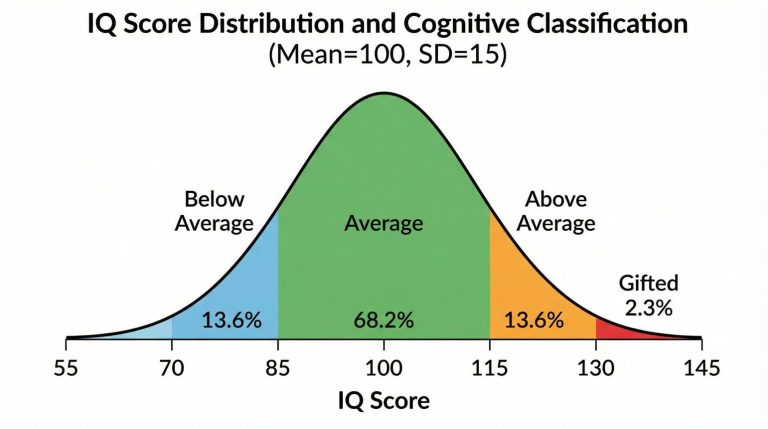
A high IQ generally refers to a score noticeably above the population average of 100. On many modern IQ tests, a score of 115 is above average, 120 is approximately at the 91st percentile, and 130 is around the 98th percentile.
However, there is no single cutoff for a “high IQ” that applies to every intelligence test or classification system.
IQ scores are best understood in relation to the test’s standardization sample, scoring method, and measurement limitations.
In this guide, we’ll explain what counts as a high IQ, compare common scores and percentiles, explore how intelligence is measured, and clarify what a high score can—and cannot—tell you.
What Is a High IQ?
A high IQ is an intelligence test score that is substantially above the average score for the relevant reference population.
Many widely used IQ tests have:
- An average score of 100.
- A standard deviation of 15.
- A distribution in which most people score relatively close to the average.
On this scale, a score of 115 is one standard deviation above average.
A score of 130 is two standard deviations above average.
That makes 130 considerably less common than 115.
What IQ Score Is Considered High?
There is no universally agreed numerical threshold.
However, the following descriptions provide a useful general guide:
- IQ 100: Average.
- IQ 110: Above the population mean.
- IQ 115: Clearly above average.
- IQ 120: Higher than approximately 91% of the modeled population.
- IQ 125: Higher than approximately 95% of the modeled population.
- IQ 130: Higher than approximately 98% of the modeled population.
- IQ 140: An exceptionally high score.
These are general descriptions, not official classification labels shared by all tests.
For example, a particular assessment may use terms such as High Average, Superior, or Very High for specific score ranges.
Those labels should be interpreted according to that assessment’s technical manual.
The important point is that IQ scores are relative measurements. A score is considered high because it is uncommon compared with the scores of an appropriate reference group.
High IQ Score Chart and Percentiles
The easiest way to understand a high IQ score is to compare it with the population average.
The chart below uses a theoretical normal distribution with a mean of 100 and a standard deviation of 15.
| IQ Score | Approximate Percentile | Percentage at or Above This Score | General Interpretation |
|---|---|---|---|
| 85 | 16th | 84.1% | Below the mean |
| 90 | 25th | 74.8% | Below the mean |
| 100 | 50th | 50% | Average |
| 105 | 63rd | 36.9% | Slightly above average |
| 110 | 75th | 25.2% | Above average |
| 115 | 84th | 15.9% | Above average |
| 120 | 91st | 9.1% | Noticeably above average |
| 125 | 95th | 4.8% | High |
| 130 | 97.7th | 2.3% | Very high |
| 135 | 99th | 1.0% | Exceptionally high |
| 140 | 99.62nd | 0.38% | Exceptionally high |
Note: Percentiles are approximate theoretical values. They assume a normal distribution with a mean of 100 and a standard deviation of 15. Individual tests may use different norms, classification systems, and score ranges.
What Does an IQ Percentile Mean?
An IQ percentile indicates how a score compares with the scores of people in a reference population.
For example, an IQ of 120 corresponds to approximately the 91st percentile.
This means the score is higher than about 91% of scores in the modeled population.
It does not mean that someone answered 91% of the test questions correctly.
Likewise, an IQ of 130 at approximately the 98th percentile doesn’t mean someone is “98% intelligent.”
Percentiles describe relative position, not the total amount of intelligence a person possesses.
For a broader overview of IQ scoring, see our guide to IQ test scores and what they mean.
Is an IQ of 110 Considered High?
An IQ of 110 is above the population average of 100.
On a scale with a standard deviation of 15, it falls around the 75th percentile.
That means a score of 110 is higher than approximately three-quarters of scores in the theoretical population distribution.
However, 110 is not usually considered exceptionally high.
It is better described as above average, although a particular test may use a different descriptive label.
What Does an IQ of 110 Suggest?
A score of 110 indicates somewhat stronger performance than the population mean on the abilities measured by the assessment.
But it does not determine someone’s academic potential, career success, creativity, or practical problem-solving skills.
Individual strengths may also differ across cognitive domains.
Someone might perform particularly well on verbal reasoning tasks while receiving a lower score on processing-speed tasks.
An overall IQ score does not reveal every aspect of that pattern.
Is an IQ of 115 Considered High?
Yes. An IQ of 115 is above average.
It is one standard deviation above the mean on a scale with an average of 100 and a standard deviation of 15.
Its theoretical percentile is approximately 84.
This means around 16% of the modeled population scores at or above this level.
How Good Is an IQ of 115?
An IQ of 115 reflects above-average performance on the cognitive abilities assessed.
It is a meaningful difference from the population mean, but it is not extraordinarily rare.
Whether it receives a label such as High Average depends on the specific test.
A score of 115 also doesn’t mean someone will necessarily perform well in every academic subject or professional setting.
Learning, achievement, and everyday functioning depend on many factors beyond a single IQ score.
Is an IQ of 120 Considered High?
Yes, an IQ of 120 is generally considered a high or noticeably above-average score.
On a standard deviation 15 scale, an IQ of 120 is approximately at the 91st percentile.
That means about 9.1% of the modeled population scores at or above 120.
In simpler terms, an IQ of 120 is higher than the scores of approximately nine out of ten people in the theoretical reference population.
How Rare Is an IQ of 120?
Under the normal-distribution model, roughly 1 in 11 people scores 120 or higher.
That makes it less common than a score of 110 or 115.
However, it is still much more common than scores of 130 or above.
Does an IQ of 120 Mean You’re Gifted?
Not necessarily.
The word gifted is used differently across educational systems and programs.
Some programs use IQ thresholds, while others consider academic achievement, creativity, specific talents, or multiple assessment measures.
An IQ of 120 may be relevant to an educational evaluation, but it does not automatically qualify someone for every gifted program.
Is an IQ of 125 Considered High?
Yes. An IQ of 125 is a high score on many modern IQ scales.
It is approximately at the 95th percentile.
That means about 4.8% of the theoretical population scores at or above this level.
An IQ of 125 is therefore considerably less common than an IQ of 115.
What Does an IQ of 125 Mean?
A score of 125 suggests strong performance relative to the reference population on the abilities measured by the test.
Depending on the assessment, it may reflect strengths in areas such as:
- Abstract reasoning.
- Verbal comprehension.
- Visual-spatial problem-solving.
- Working memory.
- Other cognitive tasks included in the assessment.
However, the overall score does not tell you which abilities contributed most strongly.
Two people with the same IQ score can have different patterns of cognitive strengths and weaknesses.
Is 125 Close to Genius IQ?
An IQ of 125 is high, but genius IQ is not a standardized clinical category.
Some popular websites use specific thresholds to describe genius-level intelligence.
Those thresholds are not universally accepted.
It is more accurate to say that 125 is approximately at the 95th percentile than to assign it a dramatic label.
Is an IQ of 130 Considered High?
Yes. An IQ of 130 is a very high score.
On a standard deviation 15 scale, it is two standard deviations above the mean.
Its theoretical percentile is approximately 97.7.
Only about 2.3% of the modeled population scores at or above this level.
That makes an IQ of 130 relatively rare.
Is 130 a Gifted IQ?
An IQ around 130 is sometimes used as one criterion for identifying intellectual giftedness.
However, educational programs and professional assessments do not all use the same definition.
Some consider additional evidence, such as achievement, particular cognitive strengths, or educational needs.
An IQ of 130 should therefore not be treated as a universal giftedness cutoff.
Is an IQ of 130 Considered Genius?
Not automatically.
The term genius has no single, universally recognized IQ threshold.
While some informal classifications describe scores of 130, 140, or 145 as genius-level, these labels are not equivalent to a standardized psychological diagnosis.
For a more detailed explanation, read Genius IQ Rating: What IQ Score Is Considered Genius?.
How Rare Is a High IQ?
The rarity of a high IQ depends on the score threshold.
If someone defines a high IQ as 115 or above, the group is relatively large.
If they define it as 130 or above, the group is much smaller.
Here is how several common thresholds compare.
| IQ Threshold | Approximate Percentage at or Above | About 1 in… |
|---|---|---|
| 110+ | 25.2% | 4 |
| 115+ | 15.9% | 6 |
| 120+ | 9.1% | 11 |
| 125+ | 4.8% | 21 |
| 130+ | 2.3% | 44 |
| 135+ | 1.0% | 102 |
| 140+ | 0.38% | 261 |
These estimates are based on a theoretical normal distribution with a mean of 100 and standard deviation of 15.
Why Are Very High IQ Scores Uncommon?
IQ tests are commonly standardized so that scores approximate a bell-shaped distribution.
Most scores cluster around the average.
As scores move farther from the mean, fewer people fall into those ranges.
For example:
- IQ 115 is one standard deviation above average.
- IQ 130 is two standard deviations above average.
- IQ 145 is three standard deviations above average.
Each step represents a less common position in the theoretical distribution.
However, a score’s rarity does not determine someone’s worth, happiness, or future achievements.
What Are the Signs of a High IQ?
People often search for signs of high intelligence in everyday behavior.
Some cognitive abilities are associated with performance on intelligence tests, but there is no reliable checklist of personality traits or habits that can reveal someone’s exact IQ.
A formal assessment measures performance directly.
Everyday observations are much less precise.
1. Strong Abstract Reasoning
Abstract reasoning involves recognizing relationships, understanding concepts, and solving problems that may not have obvious concrete answers.
Many intelligence assessments include tasks that require this ability.
However, strong reasoning in one area does not necessarily mean someone will perform equally well across every cognitive domain.
2. Pattern Recognition
Some intelligence tests examine how effectively a person identifies patterns in visual or numerical information.
For example, a test may ask someone to determine which shape logically completes a sequence.
Success on these tasks can contribute to certain reasoning scores.
But enjoying puzzles or spotting patterns in daily life does not establish a specific IQ level.
3. Effective Problem-Solving
Problem-solving can involve understanding a situation, identifying relevant information, and evaluating possible solutions.
Certain standardized cognitive tasks measure aspects of this ability.
Real-world problem-solving, however, also depends on experience, practical knowledge, motivation, and available resources.
4. Strong Verbal Comprehension
Verbal comprehension may involve understanding vocabulary, explaining relationships between concepts, and reasoning with language.
It is an important component of some widely used intelligence assessments.
However, verbal performance can be influenced by language background, educational opportunity, and other factors.
5. Working Memory Strengths
Working memory involves temporarily holding information in mind while using or manipulating it.
For example, remembering a sequence of numbers and repeating them in reverse order requires working-memory processes.
Some intelligence assessments include working-memory tasks.
Yet working memory is only one part of cognitive functioning.
6. Efficient Learning in Certain Areas
People with strong cognitive abilities may learn some kinds of information relatively efficiently.
However, learning speed varies depending on the subject, prior knowledge, instruction, motivation, and context.
A person who learns mathematics quickly may not learn a new language at the same pace.
Important: None of these observations can independently confirm a high IQ. A person’s habits, interests, social preferences, or personality type are not substitutes for standardized cognitive assessment.
How Is IQ Measured?
IQ is measured using standardized assessments designed to evaluate selected cognitive abilities.
Modern IQ tests typically compare an individual’s performance with the performance of an appropriate reference sample.
The results are converted into standardized scores.
Common Intelligence Assessments
Two established families of intelligence assessments include:
Wechsler intelligence scales
These assessments include measures of cognitive abilities such as verbal comprehension, reasoning, working memory, and processing speed, depending on the instrument and version.
Stanford–Binet intelligence scales
These assessments evaluate multiple cognitive domains and provide standardized intelligence scores.
Different instruments have different purposes, age ranges, scoring systems, and administration requirements.
Why Standardization Matters
A standardized test is developed and evaluated using systematic procedures.
These include collecting data from a reference sample and studying how consistently and appropriately the assessment measures its intended constructs.
Without suitable standardization, an IQ number may have little interpretive value.
For example, a short online quiz that reports an IQ of 135 may not provide evidence that its score is comparable to a professionally administered intelligence assessment.
Why IQ Scores Include Measurement Error
An IQ score is an estimate, not a perfectly exact measurement.
Factors such as testing conditions, fatigue, attention, health, and measurement uncertainty can affect performance.
Professional assessments may report confidence intervals around scores.
These intervals help communicate that an observed result is not infinitely precise.
For example, a reported IQ of 120 should not automatically be interpreted as meaning someone’s underlying cognitive ability is exactly 120 under all conditions.
The specific confidence interval depends on the assessment.
Does a High IQ Mean You’re Smart?
A high IQ score suggests relatively strong performance on the cognitive abilities measured by a standardized intelligence test.
But the word smart can mean many different things.
Someone might use it to describe:
- Strong analytical reasoning.
- Extensive knowledge.
- Creative thinking.
- Practical judgment.
- Social understanding.
- Effective decision-making.
- The ability to learn from experience.
IQ tests measure some aspects of cognitive ability more directly than others.
They are not designed to capture every quality people associate with intelligence.
High IQ vs. Academic Achievement
IQ scores can be associated with academic outcomes at the group level.
However, school performance also depends on factors such as instruction, motivation, study habits, health, learning opportunities, and personal circumstances.
A student with a high IQ can still struggle in school.
Likewise, someone with an average IQ can achieve excellent academic results through effective learning strategies, persistence, and support.
High IQ vs. Creativity
Creativity involves producing ideas or work that are original and useful or meaningful within a particular context.
Although reasoning abilities can contribute to creative work, creativity is not identical to IQ.
A high IQ score does not guarantee exceptional artistic, scientific, or entrepreneurial creativity.
High IQ vs. Emotional Intelligence
Emotional intelligence generally refers to abilities or characteristics related to recognizing, understanding, and managing emotions, although definitions and measurement approaches vary.
These are not the same constructs measured by a typical IQ test.
Someone can have strong analytical abilities while finding certain interpersonal situations challenging.
Another person may have excellent interpersonal skills without an unusually high IQ score.
High IQ vs. Personality Type
Personality assessments and intelligence tests answer different questions.
For example, the Myers-Briggs Type Indicator (MBTI) describes proposed personality preferences, while IQ tests assess selected cognitive abilities.
No MBTI personality type is inherently more intelligent than another.
An INTJ, INTP, INFJ, or any other four-letter type does not indicate a particular IQ score.
Can Someone Have a High IQ and Still Struggle?
Yes.
A high IQ does not protect someone from every academic, emotional, social, or practical difficulty.
Cognitive abilities are only one part of everyday functioning.
High IQ and Learning Difficulties
A person can have strong abilities in some cognitive areas while experiencing difficulties in others.
For example, someone may demonstrate advanced reasoning but struggle with particular academic skills.
A comprehensive educational or psychological evaluation may help identify a person’s strengths and support needs.
High IQ and Motivation
Intellectual ability and motivation are not the same thing.
Someone may have strong reasoning skills but feel disengaged from a particular subject or environment.
Interest, goals, feedback, and circumstances can influence effort and performance.
High IQ and Social Skills
Social communication skills develop through experience, learning, and relationships.
A high IQ score does not automatically make someone socially skilled or socially awkward.
It is inaccurate to assume that people with high intelligence are necessarily isolated, anxious, or unable to relate to others.
High IQ and Career Success
Cognitive ability can be relevant to learning and performance in certain work settings.
But professional success also depends on skills, experience, opportunity, teamwork, persistence, and many other factors.
No single IQ score can predict an individual’s career path.
What Is the Difference Between a High IQ and a Genius IQ?
The expressions high IQ and genius IQ are sometimes used interchangeably, but they don’t mean exactly the same thing.
A high IQ refers broadly to a score above the population average.
The term genius IQ is a less standardized expression often used to describe exceptionally high scores.
| Feature | High IQ | Genius IQ |
|---|---|---|
| Meaning | Above-average intelligence test performance | Informal label for exceptionally high scores |
| Commonly discussed scores | 115, 120, 125, 130 | 130, 140, 145, 160 |
| Universal cutoff | No | No |
| Scientific interpretation | Depends on the specific test and norms | The term itself is not a standardized clinical classification |
| Main consideration | How far above average a score is | Whether a score can meaningfully justify the label “genius” |
The more useful question is not whether a number sounds impressive.
It is what the score means within the assessment that produced it.
Are Online High IQ Tests Accurate?
Online IQ quizzes vary widely in quality.
Some are designed mainly for entertainment.
Others attempt to measure specific reasoning abilities.
But an online test is not automatically a validated intelligence assessment simply because it provides a numerical IQ result.
Warning Signs of an Unreliable IQ Test
Be cautious if a website:
- Provides extremely high scores after only a few questions.
- Does not explain its scoring method.
- Makes exaggerated claims about identifying geniuses.
- Provides no information about standardization.
- Suggests that a single result predicts your entire future.
- Uses a personality quiz as if it were an intelligence assessment.
How to Get a Reliable IQ Score
If you need a score for educational, clinical, or another formal purpose, consider consulting an appropriately qualified professional.
They can help determine which assessment is suitable and explain the results in context.
Professional interpretation may also clarify differences between cognitive domains and the uncertainty associated with a reported score.
For general curiosity, online quizzes can still be enjoyable, provided their results are not treated as definitive.
Can You Increase Your IQ?
IQ scores can vary over time, and cognitive performance is influenced by development, education, health, and testing circumstances.
However, there is an important distinction between improving performance on a particular task and increasing general cognitive ability.
Does Practicing IQ Questions Help?
Practicing certain question types may improve familiarity and performance on similar tasks.
For example, repeated exposure to matrix reasoning puzzles may help someone recognize common patterns more efficiently.
But better puzzle performance does not necessarily mean that all aspects of intelligence have improved.
Do Brain Training Apps Increase IQ?
Some cognitive training programs improve performance on the activities being practiced.
Evidence for broad, lasting improvements in unrelated cognitive abilities is more limited.
Claims that an app can dramatically raise someone’s IQ should be evaluated carefully.
What Habits Support Cognitive Performance?
Habits that support general health and learning include:
- Getting adequate sleep.
- Engaging in regular physical activity.
- Maintaining access to education and intellectually engaging activities.
- Managing relevant health concerns.
- Using effective learning strategies.
These habits can support cognitive functioning and well-being without guaranteeing a specific increase in IQ points.
Frequently Asked Questions
What IQ score is considered high?
There is no universal cutoff. On many modern IQ scales, 115 is above average, 120 is around the 91st percentile, and 130 is approximately the 98th percentile. Classification labels depend on the specific test.
Is 110 a high IQ?
An IQ of 110 is above average and approximately at the 75th percentile on a standard deviation 15 scale. It is higher than the population mean but is not exceptionally rare.
Is 115 a high IQ?
Yes. An IQ of 115 is one standard deviation above average and approximately at the 84th percentile. Around 15.9% of the theoretical population scores at or above this level.
Is 120 a high IQ?
Yes. An IQ of 120 is approximately at the 91st percentile, meaning about 9.1% of the theoretical population scores at or above it.
Is 125 a high IQ?
Yes. An IQ of 125 is approximately at the 95th percentile. It is a relatively uncommon score, with about 4.8% of the theoretical population scoring at or above this level.
Is 130 a high IQ?
Yes. An IQ of 130 is very high, approximately at the 97.7th percentile. It is about two standard deviations above the mean on a standard deviation 15 scale.
What percentage of people have a high IQ?
It depends on the threshold. Approximately 15.9% score 115 or higher, 9.1% score 120 or higher, and 2.3% score 130 or higher under a theoretical normal distribution with mean 100 and standard deviation 15.
What is the difference between a high IQ and a genius IQ?
High IQ refers to above-average intelligence test performance. Genius IQ is an informal expression for exceptionally high scores, but there is no universally accepted IQ cutoff defining genius.
Can you have a high IQ and still struggle in school?
Yes. Academic performance depends on many factors, including learning opportunities, motivation, health, instructional quality, and specific academic skills. A high IQ does not guarantee strong performance in every subject.
Are online IQ tests accurate?
Accuracy varies. Many casual online quizzes lack the standardization and measurement evidence needed to interpret scores as formal IQ results. A professionally administered, appropriately standardized assessment is more suitable when a reliable score is needed.
Final Thoughts
So, what is a high IQ?
On many modern IQ scales, the average score is 100, and scores of 115, 120, and 130 represent increasingly uncommon levels of cognitive test performance.
An IQ of 115 is above average.
An IQ of 120 is approximately at the 91st percentile.
An IQ of 125 is around the 95th percentile.
And an IQ of 130 is approximately at the 98th percentile.
But a high IQ score is only one piece of information about a person.
It does not fully measure creativity, character, emotional understanding, practical judgment, or the ability to build a meaningful life.
If you’re interpreting an IQ result, focus on the assessment’s norms, the score’s percentile, and its measurement limitations rather than relying on labels such as “smart” or “genius.”
A high IQ describes performance on certain cognitive measures—not the limits of what a person can learn, achieve, or become.
Sources and Further Reading
- Pearson Assessments — Information on standardized cognitive assessments, including Wechsler intelligence scales.
- Mensa International — Information about qualifying intelligence tests and high-IQ society admission criteria.
- American Psychological Association — Professional resources on psychological assessment and intelligence research.
- National Center for Education Statistics — Information and research on educational measurement and outcomes.
Editorial note: Percentiles and population percentages in this article are theoretical estimates based on a normal distribution with a mean of 100 and standard deviation of 15. They are not substitutes for the norms, confidence intervals, or professional interpretation of a specific intelligence assessment.