Have you ever taken an IQ test and wondered what your score actually means?
Maybe you received an IQ score of 100 and want to know whether that’s average. Or perhaps you scored 115, 120, or 130 and are curious about how your result compares with other people’s scores.
IQ test scores are designed to describe certain cognitive abilities relative to a standardized comparison group. But the numbers can be confusing, especially when different websites use different labels for the same score.
An IQ of 120, for example, does not mean you answered 120 questions correctly. And a score of 130 does not mean someone is 30% more intelligent than a person with an IQ of 100.
This guide explains IQ score ranges, percentiles, average and high IQ scores, and what your results can—and cannot—tell you.
IQ Score Chart: Ranges and Percentiles
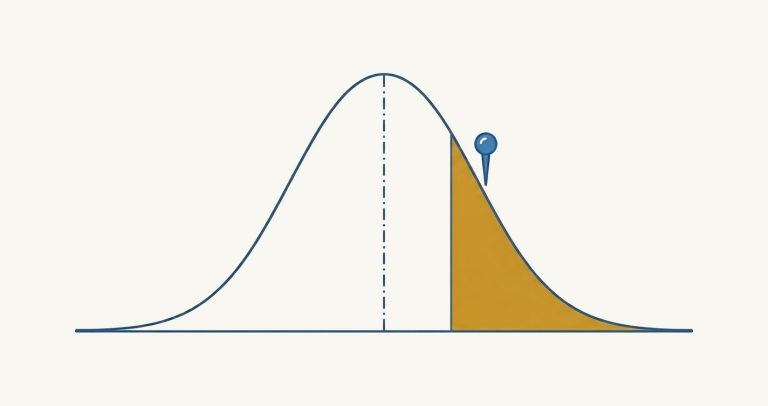
Most widely used modern IQ tests report standardized scores with a mean of 100 and a standard deviation of 15.
That means 100 is the average score in the test’s reference population, and approximately two-thirds of scores fall between 85 and 115.
The following IQ score chart shows how scores are commonly distributed.
| IQ Score Range | General Description | Approximate Percentile Range |
|---|---|---|
| Below 70 | Significantly below average | Below 2nd |
| 70–79 | Well below average | 2nd–8th |
| 80–89 | Below average | 9th–25th |
| 90–109 | Average range | 25th–75th |
| 110–119 | Above average | 75th–91st |
| 120–129 | Well above average | 91st–98th |
| 130 and above | Very high | 98th and above |
Note: These are approximate descriptive ranges based on a normal distribution with a mean of 100 and standard deviation of 15. Category labels are not universal and may differ between standardized tests. Percentile boundaries are rounded.
How to Read the IQ Score Chart
Suppose your IQ score is 115.
On a commonly used IQ scale, 115 is one standard deviation above the mean. That corresponds to approximately the 84th percentile.
In other words, your score is higher than approximately 84% of scores in the relevant reference population.
A score of 100 corresponds to the 50th percentile.
A score of 130 corresponds to approximately the 98th percentile.
These percentiles describe relative test performance, not a person’s overall worth, potential, or likelihood of success.
What Do IQ Test Scores Mean?
IQ stands for intelligence quotient.
Modern IQ tests measure performance on selected cognitive tasks and compare that performance with results from a standardized reference group.
Depending on the test, the assessment may include tasks involving:
- Verbal reasoning and comprehension.
- Visual and spatial reasoning.
- Working memory.
- Processing speed.
- Pattern recognition.
- Fluid reasoning and problem-solving.
Not every IQ test measures all these abilities, and different tests may organize them into different scales.
A professionally administered assessment may provide both an overall IQ score and scores for individual cognitive domains.
IQ Scores Are Relative, Not Absolute
An IQ score is not a direct measurement of intelligence in the same way a ruler measures length.
It is a standardized result.
The meaning of the score depends on the test, the reference population, and how the assessment was administered.
For example, a score of 110 on a properly standardized test generally indicates performance above the average of its reference group.
It does not mean that someone possesses a fixed quantity of intelligence equal to 110 units.
IQ Scores Are Not Percentages
An IQ score of 120 does not mean someone is 20% smarter than average.
Likewise, an IQ of 90 does not mean someone has 90% of normal intelligence.
IQ scores use a standardized scale rather than a percentage scale.
To understand a score, it is usually more useful to look at its percentile.
What Is the Average IQ Score?
The average IQ score is 100 on most modern IQ tests that use a mean of 100 and a standard deviation of 15.
This average is established through standardization.
Test developers administer the assessment to a reference sample and use the results to create scoring norms.
What Is a Normal IQ Range?
There is no single universally defined “normal” IQ range across all assessments.
However, a broad range of approximately 85 to 115 is often used to describe scores within one standard deviation of the mean.
Under a normal distribution, about 68% of scores fall within that interval.
A wider range of approximately 70 to 130 covers about 95% of scores.
These ranges describe the distribution of standardized test results.
They should not be interpreted as boundaries separating people into categories of personal value or capability.
Is an IQ of 100 Good?
Yes. An IQ of 100 is exactly average on a scale with a mean of 100.
It corresponds to approximately the 50th percentile.
This means the score is near the middle of the reference distribution.
It does not suggest that someone lacks intelligence or ability.
A person’s strengths may also vary considerably across different cognitive tasks.
IQ Scores and Percentiles: What Does Your Score Mean?
One of the most useful ways to interpret an IQ score is to compare it with its approximate percentile.
The table below assumes a standardized IQ scale with a mean of 100 and standard deviation of 15.
IQ Score Percentile Chart
| IQ Score | Approximate Percentile | Interpretation |
|---|---|---|
| 70 | 2nd | Well below average |
| 75 | 5th | Below average |
| 80 | 9th | Below average |
| 85 | 16th | Below average |
| 90 | 25th | Lower end of average range |
| 95 | 37th | Average |
| 100 | 50th | Average |
| 105 | 63rd | Average |
| 110 | 75th | Above average |
| 115 | 84th | Above average |
| 120 | 91st | Well above average |
| 125 | 95th | Well above average |
| 130 | 98th | Very high |
| 135 | 99th | Very high |
| 140 | 99.6th | Exceptionally high |
| 145 | 99.9th | Exceptionally high |
Percentiles are theoretical approximations. Actual reported percentiles may differ slightly because of test norms, rounding, and scoring methods.
What Does an IQ of 90 Mean?
An IQ score of 90 is approximately at the 25th percentile.
That means it is higher than about one-quarter of scores in the reference population.
It is within the broad average range used in many informal explanations, although specific tests may use different descriptive labels.
A score of 90 alone cannot determine someone’s academic ability, job performance, or future achievements.
What Does an IQ of 100 Mean?
An IQ of 100 represents the average score.
It corresponds to the 50th percentile.
Approximately half of the reference population scores above this level and half scores below it.
What Does an IQ of 110 Mean?
An IQ of 110 is approximately at the 75th percentile.
It indicates performance above the mean on the standardized scale.
Someone with this result may perform relatively well on the cognitive tasks measured by the test, but the score does not describe every aspect of their abilities.
What Does an IQ of 115 Mean?
An IQ of 115 is approximately at the 84th percentile.
It is one standard deviation above the mean.
On a normally distributed scale, approximately 16% of scores are higher than 115.
What Does an IQ of 120 Mean?
An IQ of 120 is approximately at the 91st percentile.
This means the score is higher than about 91% of the reference population.
It is commonly described as well above average.
However, the score should be interpreted using the test’s own classification system.
What Does an IQ of 125 Mean?
An IQ of 125 is approximately at the 95th percentile.
Only about 5% of scores are higher under the assumed distribution.
This is a relatively uncommon score, although it is not sufficient on its own to establish eligibility for a particular gifted program or organization.
What Does an IQ of 130 Mean?
An IQ of 130 is approximately at the 98th percentile.
That places it around two standard deviations above the mean.
On a normal distribution with a mean of 100 and standard deviation of 15, approximately 2.3% of scores are at or above 130.
This is why IQ 130 is often discussed in connection with high intellectual ability.
However, different educational programs and high-IQ organizations use their own eligibility rules.
What Does an IQ of 140 Mean?
An IQ of 140 corresponds to approximately the 99.6th percentile.
This means fewer than 1% of scores are higher under the assumed distribution.
It is an unusually high result.
At this level, accurate interpretation depends especially on the test’s measurement precision, ceiling, and standardization.
A very high score from an informal online quiz should not automatically be treated as equivalent to a professionally administered assessment.
What Is Considered a Good IQ Score?
There is no universal definition of a “good” IQ score.
If the question is whether a score is above average, then a result above 100 is above the mean on the standard scale.
But intelligence testing is not a competition in which a single number determines someone’s potential.
A person’s capabilities depend on many factors, including:
- Knowledge and experience.
- Motivation and persistence.
- Educational opportunities.
- Practical problem-solving.
- Social and communication skills.
- Creativity.
- Emotional regulation.
- Physical and mental health.
An IQ score may provide useful information about performance on certain cognitive tasks.
It does not measure all these qualities.
Is a Higher IQ Always Better?
A higher score indicates stronger performance relative to the reference population on the abilities measured.
It does not guarantee better decisions, stronger relationships, financial success, or happiness.
Similarly, an average score does not prevent someone from developing specialized expertise or achieving meaningful goals.
IQ results are best understood as one source of information rather than a complete description of a person.
What Is Considered a High IQ Score?
A score of 115 or higher is above the mean by at least one standard deviation on the commonly used scale.
Scores of 120, 125, and 130 are progressively less common.
An IQ of 130 or above is often described as very high.
However, there is no single universal cutoff for terms such as gifted, highly gifted, or genius.
Is IQ 130 Considered Gifted?
Some gifted education programs use IQ scores around 130 as one possible criterion.
Others consider achievement, creativity, teacher observations, portfolios, or multiple measures of ability.
Eligibility varies by school system and program.
A score of 130 should therefore not be treated as a universal gifted diagnosis.
What IQ Score Is Needed for Mensa?
Mensa generally requires qualifying performance at or above the 98th percentile on an accepted, properly administered intelligence test.
That is approximately equivalent to an IQ of 130 on a scale with a mean of 100 and standard deviation of 15.
However, the exact numerical cutoff varies by test.
Mensa evaluates accepted test results according to its own rules.
For current requirements, consult the official Mensa website.
How Are IQ Test Scores Calculated?
Modern IQ scores are typically derived from standardized testing and age-appropriate norms.
They are not usually calculated by simply dividing a person’s mental age by their chronological age.
That older approach played a role in the history of IQ testing, but it does not describe how most modern standardized intelligence tests are scored.
Step 1: Complete the Assessment
The person completes tasks designed to measure selected cognitive abilities.
Depending on the test, these may involve vocabulary, patterns, visual puzzles, memory, or processing speed.
Step 2: Calculate Raw Scores
The examiner or scoring system determines performance on the individual tasks.
A raw score may represent the number of correct answers, completion time, or another task-specific measurement.
Step 3: Compare Results With Norms
The raw results are compared with those of an appropriate reference population.
Many intelligence tests use age-based norms.
This helps make the scores meaningful for people at different developmental stages.
Step 4: Convert Results to Standard Scores
The results are converted into standardized scores.
On the familiar IQ scale:
- Mean = 100.
- Standard deviation = 15.
- Approximately 68% of scores fall between 85 and 115.
- Approximately 95% fall between 70 and 130.
These properties are based on the test’s standardization model.
Step 5: Interpret the Results
A qualified professional may consider the overall score, individual cognitive domains, confidence intervals, behavioral observations, and other relevant information.
A single number rarely captures everything that can be learned from a comprehensive assessment.
What Is an IQ Percentile?
An IQ percentile indicates where a score falls relative to the reference population.
For example:
IQ 100 = approximately 50th percentile.
IQ 115 = approximately 84th percentile.
IQ 130 = approximately 98th percentile.
A percentile is not the percentage of questions answered correctly.
IQ Percentile vs. IQ Score
| Term | Meaning |
|---|---|
| IQ score | A standardized measure of test performance |
| Percentile rank | The percentage of reference scores at or below a given level, subject to reporting conventions |
| Raw score | Performance before conversion to standardized norms |
| Standard deviation | A measure of how spread out scores are around the mean |
| Confidence interval | A range that reflects uncertainty in the estimated score |
Why Percentiles Are Helpful
Percentiles make it easier to understand relative performance.
A difference of 10 IQ points does not correspond to a fixed difference of 10 percentile points.
For example, the difference between IQ 100 and IQ 110 is approximately 25 percentile points.
But the difference between IQ 130 and IQ 140 is only about 1.9 percentile points.
That happens because scores become less common toward the extremes of the distribution.
Are Online IQ Test Scores Accurate?
Online IQ tests vary widely in quality.
Some are designed primarily for entertainment.
Others may use standardized procedures or have published evidence supporting their measurement properties.
The fact that a test is available online does not automatically make it unreliable.
But a website’s claim to measure IQ is not, by itself, evidence that the test is valid.
What Makes an IQ Test Reliable?
A credible assessment should have evidence supporting its intended use.
Important considerations include:
Standardization: Was the test developed and scored using an appropriate reference sample?
Reliability: Does the assessment produce reasonably consistent results under appropriate conditions?
Validity: Is there evidence that the test measures the abilities it claims to measure?
Norms: Are the comparison groups suitable for the person taking the test?
Administration: Are the testing conditions consistent with the test’s requirements?
Interpretation: Are the results explained with appropriate attention to uncertainty and limitations?
Online IQ Test vs. Professional IQ Assessment
| Feature | Informal Online IQ Quiz | Professional Standardized Assessment |
|---|---|---|
| Purpose | Often entertainment or self-exploration | Structured cognitive assessment |
| Standardized norms | May be unavailable | Expected for established instruments |
| Administration | Usually self-directed | Follows specified procedures |
| Reliability evidence | Often unclear | Documented in technical materials |
| Detailed cognitive profile | Often limited | May include multiple index scores |
| Clinical or educational interpretation | Generally unsuitable | May inform professional evaluations |
This comparison describes typical differences, not every online test.
Some professionally developed assessments may also use digital administration.
Can You Trust a Free IQ Test?
A free test can be entertaining or useful for practicing certain types of questions.
However, be cautious if it:
- Promises an exact IQ score without explaining its norms.
- Claims to diagnose intellectual disabilities.
- Advertises extraordinary accuracy without evidence.
- Uses only a handful of questions.
- Presents dramatic rankings without explaining its scoring.
- Requires payment to reveal a supposedly definitive result.
If you need IQ results for educational, clinical, or formal eligibility purposes, ask a qualified professional about an appropriate standardized assessment.
Can Your IQ Score Change Over Time?
Yes. IQ test scores can vary across assessments and over time.
However, not every difference represents a meaningful change in cognitive ability.
Measurement Error
All psychological tests involve some measurement uncertainty.
A reported IQ score is an estimate rather than a perfectly precise number.
Professional reports may include confidence intervals to communicate that uncertainty.
Practice Effects
Taking similar tests repeatedly can improve familiarity with the tasks.
A higher score on a later attempt may partly reflect practice rather than a broad change in cognitive ability.
Sleep, Stress, and Health
Fatigue, stress, illness, attention, and other testing conditions can influence performance.
The extent of their effects varies by person and assessment.
Development and Aging
Cognitive abilities change across childhood, adolescence, adulthood, and later life.
Because many tests use age-based norms, a person’s standardized score reflects performance relative to others of a similar age rather than simply measuring how much they know.
Differences Between Tests
Two assessments may emphasize different abilities or use different norms.
Their scores may not be directly interchangeable.
A meaningful interpretation should consider the instruments used, the time between assessments, and the reason for testing.
Can IQ Test Scores Diagnose Intellectual Disability?
No. An IQ score alone is not sufficient to diagnose intellectual disability.
Clinical evaluation involves more than a numerical cutoff.
According to the American Association on Intellectual and Developmental Disabilities, intellectual disability involves significant limitations in both intellectual functioning and adaptive behavior, with onset during the developmental period.
Adaptive behavior includes conceptual, social, and practical skills used in everyday life.
A score near or below 70 may be relevant in an assessment, but professionals must consider measurement error, adaptive functioning, developmental history, and other information.
It is inappropriate to label someone based solely on a score from an online quiz.
What IQ Tests Cannot Tell You
IQ assessments can provide information about selected cognitive abilities.
They do not provide a complete picture of a person.
Creativity
Some aspects of creative thinking may overlap with abilities assessed by intelligence tests.
However, a standard IQ score does not directly measure the full range of artistic, imaginative, or creative accomplishments.
Emotional Intelligence
Understanding and managing emotions involves skills that are not fully represented by a conventional IQ score.
Personality
An IQ test does not tell you whether someone is kind, honest, outgoing, patient, or dependable.
Motivation
A person’s willingness to practice, learn, and persist through challenges is not captured by a single IQ result.
Relationship Quality
Communication, empathy, respect, and trust are central to healthy relationships.
IQ scores cannot determine whether someone will be a good friend or romantic partner.
For more on relationship qualities, explore our healthy relationship checklist.
Future Success
Cognitive ability may be relevant to performance in some educational and occupational settings.
But life outcomes are influenced by many interacting factors.
An IQ score cannot predict an individual’s future with certainty.
How to Interpret Your IQ Test Results Responsibly
If you’ve received an IQ score, these steps can help you understand it more accurately.
1. Identify the Test
Find out which assessment you took.
Different instruments may use different scoring systems.
2. Check the Standard Deviation
Do not assume every IQ scale uses a standard deviation of 15.
Some tests use different scales.
3. Look at the Percentile
The percentile often provides a clearer explanation of relative performance than the raw IQ number alone.
4. Review the Confidence Interval
If your report includes a confidence interval, consider the range rather than treating the reported score as perfectly exact.
5. Consider Individual Strengths
A comprehensive assessment may reveal differences between verbal reasoning, working memory, processing speed, and other abilities.
These differences can be more informative than focusing exclusively on the overall score.
6. Avoid Comparing Unrelated Tests
Scores from different instruments may not be directly comparable.
7. Ask a Professional When the Result Matters
If the assessment will influence educational placement, clinical decisions, or access to services, seek interpretation from a qualified professional.
A casual online score should not replace a formal evaluation.
Frequently Asked Questions About IQ Test Scores
What is a normal IQ test score?
Most modern IQ tests use an average score of 100. A broad range of approximately 85 to 115 covers about 68% of scores on a scale with a standard deviation of 15. Specific tests may use different descriptive categories.
What is the average IQ score?
The average IQ score is 100 on most widely used modern standardized IQ scales.
Is an IQ score of 100 good?
An IQ of 100 is average and corresponds to approximately the 50th percentile. It is a typical result and does not limit a person’s potential.
Is 110 a good IQ score?
An IQ of 110 is above average and corresponds to approximately the 75th percentile on a standard IQ scale.
Is an IQ score of 120 high?
Yes. An IQ of 120 is well above average and corresponds to approximately the 91st percentile.
What does an IQ score of 130 mean?
An IQ of 130 is approximately at the 98th percentile. It is a very high score on a scale with a mean of 100 and standard deviation of 15.
What percentile is an IQ of 140?
An IQ of 140 is approximately at the 99.6th percentile on a standard IQ scale.
What IQ score is considered gifted?
Some gifted education programs use scores around 130 as one possible criterion, but there is no universal cutoff. Eligibility depends on the program and its assessment requirements.
How accurate are online IQ test scores?
Accuracy varies. Many online quizzes lack published evidence of standardization, reliability, or validity. Professionally developed assessments are generally more appropriate when a score will be used for important decisions.
Can your IQ score change?
Yes. Scores can vary because of measurement error, practice effects, testing conditions, development, and differences between assessments. A score change does not always indicate a meaningful change in cognitive ability.
What is the highest possible IQ score?
There is no single maximum IQ score across all tests. Each assessment has its own scoring range and measurement limits. Extremely high scores require particularly careful interpretation.
Does a high IQ guarantee success?
No. IQ scores measure selected cognitive abilities. Success also depends on motivation, opportunity, health, relationships, experience, and many other factors.
Final Thoughts
IQ test scores are most useful when interpreted as standardized measures of performance rather than labels that define a person.
On the commonly used IQ scale, 100 is average, 115 is approximately the 84th percentile, and 130 is approximately the 98th percentile.
These numbers can help you understand where a result falls within a reference population.
But an IQ score is not a measure of your worth, personality, creativity, or future success.
If you took an online IQ test, consider the quality of the assessment before drawing conclusions from the result.
And if your score is being used for an important educational or clinical decision, professional interpretation is essential.
The most important question is not simply “What is my IQ score?” but “What does this assessment actually measure, and how should I use the information?”
Sources and Further Reading
Pearson Assessments — Cognitive and Intelligence Assessments
https://www.pearsonassessments.com/
Information about professionally developed cognitive assessments, including the Wechsler family of intelligence tests.
American Association on Intellectual and Developmental Disabilities (AAIDD)
https://www.aaidd.org/intellectual-disability/definition
Professional guidance on the definition of intellectual disability, intellectual functioning, and adaptive behavior.
American Psychological Association (APA)
https://www.apa.org/
Resources on psychological testing, assessment, and cognitive research.
Mensa International
https://www.mensa.org/
Information about qualifying intelligence test results and high-percentile admission requirements.
Editorial Note: The percentile estimates in this article assume a normally distributed IQ scale with a mean of 100 and standard deviation of 15. Actual score classifications and percentiles may vary by test. This article is for educational purposes and is not a substitute for professional psychological assessment.